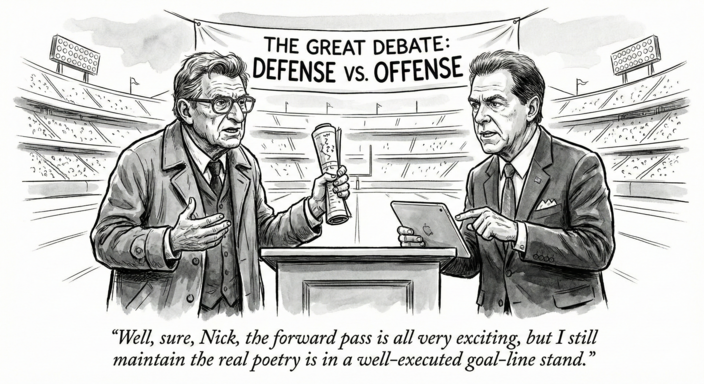
It’s the oldest argument in football, and it’s never been settled. Does defense win championships, or has the game evolved past that truism? To find out, we put two of the greatest coaches in college football history on opposite sides of the question.
Joe Paterno — the legendary Penn State coach who built dynasties on physical, punishing defense — believes the line of scrimmage is where games are won and lost. Nick Saban — the architect of Alabama’s modern dynasty and “The Process” — believes defense sets the tone but offense puts points on the board, and points win championships. They went three rounds plus closing statements, and the result was a razor-thin tie: 84 to 89, within the 5-point threshold. That near-deadlock tells you everything about how alive this debate still is.
The Case for Defense
Paterno opened with a declaration of first principles: “Football, real football, is about controlling the line of scrimmage.” His argument was built on a single, unyielding foundation — stop the run, and everything else falls into place.
A dominant run defense, in Paterno’s framework, is a machine that generates its own opportunities. It forces turnovers by demoralizing opponents into desperation. It gives the offense short fields. It controls the clock and dictates tempo. “Championship teams aren’t built on 70-60 shootouts,” he insisted. “They’re built on being able to play a complete game, and a complete game starts with a defense that doesn’t yield an inch.”
He went after modern spread offenses directly, calling them “predicated on avoiding contact” and “fragile” — schemes that crumble when they face a truly physical defense. And he saved his sharpest critique for the idea that you need to score 35 or 40 points to win: those high-scoring teams, he argued, won not because of their offenses but despite defensive vulnerabilities. “Scoring points is a result of that dominance, not the other way around.”
The Case for the Process
Saban came in with respect — “a great coach, no question” — and then methodically dismantled the premise. The game has changed. Focusing solely on stopping the run is “becoming antiquated.” And opportunity without conversion is just wasted possessions.
His core argument was complementary football: defense creates opportunities, but the offense must be built to capitalize on them and generate scoring drives independently. “Relying solely on turnovers — hoping for a short field — is a gamble,” he said. “Our offense needs to be built to create scoring opportunities, not just capitalize on others’ mistakes.”
Saban didn’t concede the line of scrimmage — he expanded it. “Dominate the line of scrimmage, yes, but also dominate the scoreboard.” He pointed to the last decade of college football, where championship teams were consistently scoring 35, 40, even 50 points a game. And he reframed “The Process” not as abandoning fundamentals, but as adapting them: “You can’t just hit ‘em in the mouth and expect to win every time. You have to be able to hit ‘em in the mouth and throw the ball over their heads.”
Where They Clashed Hardest
The debate caught fire over whether high-scoring championship teams won because of or despite their offenses. Paterno pointed to the Chiefs, Eagles, and LSU and insisted their wins came against defenses that weren’t truly elite at stopping the run — “a house of cards.” Saban fired back that those teams won “because they were able to sustain drives, convert third downs, and exploit mismatches after establishing a physical presence.”
The eight-in-the-box exchange was equally sharp. Paterno argued that stacking the box is the surest way to rattle a quarterback: “When a quarterback knows he’s facing 8 in the box, that’s when he’s rattled.” Saban countered that modern offenses are specifically designed to punish that approach — RPOs, quick passes, and spread formations neutralize those numbers. “If you only focus on stopping the run, you become predictable.”
They also tangled over whether turnovers are a cause or a consequence. Paterno framed them as the inevitable product of a demoralized offense “forced to take risks.” Saban flipped the logic: “A relentless defense forces those mistakes, but a consistent offense minimizes them.” For Saban, turnovers are a byproduct of good defense, not a strategy to build around.
And perhaps the sharpest exchange came when Paterno called “The Process” nothing more than “a sophisticated way of saying you need to be good at everything.” Saban’s response was pointed: “It’s about building a system that adapts to the opponent’s weaknesses,” not a one-size-fits-all philosophy but a framework for dominance on every down.
The Verdict — and Why the Tie Matters
The judges scored it 84-89 in Saban’s favor — but with only a 5-point gap, it falls within the tie threshold. Saban earned a slight edge in evidence and direct engagement, consistently referencing modern schemes and challenging Paterno’s premises with targeted counter-arguments. Paterno scored nearly as high with vivid rhetoric and an emotionally powerful, internally consistent worldview.
The tie feels right because this tension isn’t going away. Every football season produces a new case study: a defensive juggernaut that suffocates its way to a title, or an offensive powerhouse that puts up 45 and dares the other team to keep up. The truth, as it usually does, probably lives somewhere in the middle — but neither Paterno nor Saban was willing to give that ground, and the debate was better for it.
Maybe the real answer is that “defense wins championships” and “you’ve gotta score points” aren’t contradictions at all. They’re two halves of the same coin. The coaches who figure out how to hold both ideas in tension — demanding a relentless defense while building an offense that can bury opponents — are the ones who build dynasties. Paterno knew that. Saban knows it too. They just disagree about which half comes first.
How This Was Generated
This debate was generated by the Joshua8.AI Chatbot Debate Platform, which runs locally on consumer hardware. Two AI personas were given opposing positions on whether defense or offense wins championships, and debated across multiple rounds.
Important Disclaimer: The “Joe Paterno” and “Nick Saban” personas in this debate are AI-generated characters inspired by real public figures. The arguments, opinions, phrasing, and positions expressed are entirely AI-generated and do not represent the actual views, statements, or beliefs of the real Joe Paterno or Nick Saban. This content is fictional and created for entertainment and educational purposes only.
Participants
Joe Paterno
“Line up, hit ‘em in the mouth, and stop the run—that’s how you build winners, not this gimmicky spread stuff that folds under pressure!”
Nick Saban
“Defense sets the tone, but you’ve gotta score points in this era—the Process evolves to dominate both sides, or you’re left in the dust.”
Transcript
Turn 1: Joe Paterno
Good evening. Let’s be clear: football, real football, is about controlling the line of scrimmage. It’s about imposing your will, physically dominating your opponent, and stopping the run. “Defense Wins Championships” isn’t a slogan, it’s a fundamental truth etched in the history of this game.
Look at my Penn State teams. We weren’t chasing flashy point totals. We built a fortress, a relentless defense that suffocated offenses. We prided ourselves on being able to stop anyone from running the ball. It forces turnovers, short fields for your offense, and a demoralized opponent.
These modern offenses, all spread formations and passing, passing, passing… they’re predicated on avoiding contact. They’re fragile. When you face a truly physical defense, one that can consistently pressure the quarterback and shut down the run game, they crumble. They become one-dimensional.
Championship teams aren’t built on 70-60 shootouts. They’re built on being able to play a complete game, and a complete game starts with a defense that doesn’t yield an inch. Line up, hit ‘em in the mouth, and stop the run. That’s the bedrock of success, and that’s how you build winners that last.
Turn 2: Nick Saban
Now, Joe, with all due respect – and I mean that sincerely, a great coach – focusing solely on stopping the run is…well, it’s becoming antiquated. You built a dynasty, no question, and I admire that. But the game has changed. These offenses you call “fragile” are designed to exploit weaknesses, and frankly, defenses haven’t kept pace for too long.
You talk about imposing your will. I agree! But imposing your will now means both sides of the ball dominating. A relentless defense creates opportunities, absolutely. But if your offense can’t convert those opportunities into points, you’re leaving possessions on the field, giving the other team more chances.
Look at the last decade of college football. Teams consistently winning championships aren’t just stopping the run; they’re scoring 35, 40, even 50 points a game. The modern game demands efficiency and explosiveness.
The Process isn’t about ignoring what made us successful in the past, it’s about adapting. You can’t just hit ‘em in the mouth and expect to win every time. You have to be able to hit ‘em in the mouth and throw the ball over their heads. Dominate the line of scrimmage, yes, but also dominate the scoreboard. That’s what separates contenders from champions today.
Turn 3: Joe Paterno
Nick, I appreciate the respect, and I’ve always admired your own success. But “adapting” shouldn’t mean abandoning the fundamentals. You’re right, teams are scoring more points. But let’s look closer. How many of those high-scoring offenses sustain success when they face a truly elite, physical defense? The answer is…not many.
You talk about creating opportunities. A defense that consistently gets stops is the opportunity! It’s a far more reliable path to victory than relying on a quarterback to be perfect every single snap. Quarterbacks get rattled, receivers drop passes, offensive lines break down. It happens. But a relentless run defense? That’s consistency.
Look at the NFL. The teams that consistently win championships aren’t the highest-scoring, they’re the teams that control the line of scrimmage and dictate the game. They force opponents into predictable passing situations.
This isn’t about ignoring the pass; it’s about prioritizing what truly matters. You can’t spread formations and quick passes your way to a championship if you can’t stop the run. It’s a fundamental weakness. It’s a facade. Line up, establish dominance, and shut down the opponent’s running game. That’s the foundation, and it always will be. Scoring points is a result of that dominance, not the other way around.
Turn 4: Nick Saban
Now, Joe, you’re a master of the fundamental, I’ll grant you that. But you’re looking at the NFL, and frankly, even that league is evolving. While controlling the line of scrimmage is crucial – and we absolutely strive for that – to say elite offenses haven’t sustained success against physical defenses simply isn’t accurate. Look at the Chiefs, the Eagles last year, even teams like LSU recently. They were physical, they did control the line, but they also had offenses that could exploit any mismatch.
You’re right, a consistent run defense is an opportunity. But opportunity doesn’t guarantee points. And in today’s game, possessions are too precious to waste. Relying solely on turnovers – hoping for a short field – is a gamble. We want turnovers, absolutely, but our offense needs to be built to create scoring opportunities, not just capitalize on others’ mistakes.
You mention quarterbacks getting rattled. Of course they do! But today’s quarterbacks are also trained to process information faster, make quicker reads, and extend plays. They’re more resilient. The best defenses don’t just pressure; they disguise pressure, they confuse, and they force quarterbacks into difficult decisions while still being able to cover downfield.
The Process isn’t about abandoning fundamentals, Joe. It’s about recognizing that the game is dynamic. You can’t win consistently with a one-dimensional approach. You need to be able to stop the run and throw the ball. Defense sets the tone, sure, but you’ve gotta score points. You dominate both sides, or you’re going to get passed by. That’s the reality of the modern game, and that’s how you build a lasting dynasty.
Turn 5: Joe Paterno
Nick, you talk about the Chiefs, the Eagles, LSU – and I’ll concede they’re talented teams. But let’s be honest, those teams weren’t winning because of their spread offenses, they were winning despite vulnerabilities. Look closer at the defenses they faced in crucial moments. Were those defenses truly elite at stopping the run? Often, no. They relied on bending, not breaking, hoping to contain enough to let their offenses shine. That’s not a foundation, that’s a house of cards.
You mention quarterbacks being more resilient. Resilient to what? Pressure! And the best way to generate pressure isn’t fancy blitz packages, it’s consistently forcing predictable passing downs through a dominant run defense. When a quarterback knows he’s facing 8 in the box, that’s when he’s rattled. That’s when mistakes happen.
“Possessions are too precious to waste?” Absolutely. And the best way to secure those possessions is to control the clock with a strong running game, enabled by a defense that consistently gets off the field. Turnovers aren’t hoped for, they’re created by a demoralized offense constantly playing from behind, forced to take risks.
The “Process” sounds impressive, Nick, but it’s just a sophisticated way of saying you need to be good at everything. But you can’t be good at everything without a core strength. For us, that core strength was always the line of scrimmage. It allows you to dictate the terms of the game, to control the tempo, and to wear down your opponent.
You talk about being dynamic. True dynamism comes from a relentless defense that allows your offense to play with confidence and control, not from a quarterback bailing them out of predictable situations. Line up, establish dominance, and stop the run. It’s not antiquated, it’s timeless. And it’s the only way to build a dynasty that truly endures.
Turn 6: Nick Saban
Joe, you’re a legend, and I respect your unwavering belief in the fundamentals. But you keep framing this as an either/or proposition, and that’s where we fundamentally disagree. It’s not about abandoning the line of scrimmage—it’s about evolving with it. To say those championship teams won despite offensive strengths is a mischaracterization. They won because they were able to sustain drives, convert third downs, and exploit mismatches after establishing a physical presence.
You talk about quarterbacks being rattled by eight in the box. That worked for a long time, Joe, and it’s still part of the game. But today’s offenses are built to counter that. They use RPOs, quick passes, and spread formations to neutralize those numbers. If you only focus on stopping the run, you become predictable. Smart offensive coordinators will exploit that every time.
And saying turnovers are “created by a demoralized offense” – that’s a consequence, not a cause. A relentless defense forces those mistakes, but a consistent offense minimizes them. We aim for a defense that prevents long drives and a complimentary offense that capitalizes on short fields and consistently moves the ball down the field, even when the field isn’t short.
The “Process” isn’t about being good at everything, Joe; it’s about building a system that adapts to the opponent’s weaknesses. A truly dominant defense isn’t just about stopping the run; it’s about dictating the terms of engagement on every down. And in today’s game, that means being able to effectively defend the pass and support an offense capable of scoring 35+ points. You can’t control the clock if you can’t consistently get first downs. And you can’t consistently get first downs without a balanced attack. Defense sets the tone, but you’ve gotta score points. It’s the only way to survive, Joe, let alone build a dynasty that lasts.
Closing Statement: Joe Paterno
Gentlemen, the core of this debate boils down to control versus chaos. Nick speaks of “adapting,” but adaptation without a foundation is simply reacting. We’ve consistently demonstrated that a dominant run defense – controlling the line, dictating tempo – creates the opportunities for sustained success. Their offenses “exploit” when defenses are already compromised.
Nick frames turnovers as a consequence, but they’re the result of a demoralized opponent forced into desperation. He argues for balance, but balance is a result of defensive control, not a prerequisite. This isn’t about ignoring the pass; it’s about establishing dominance where games are won and lost. Line up, hit ‘em in the mouth, and stop the run. That’s how you build winners, and that’s how you endure.
Closing Statement: Nick Saban
Gentlemen, Joe fundamentally clings to a timeless ideal, but football isn’t timeless – it evolves. He says adaptation is reaction; we say it’s survival. The clash is simple: control versus consistent winning. His defense creates opportunities through demoralization, we guarantee them through complimentary football. LSU, the Chiefs, the Eagles – they didn’t win despite offense, they won because they could score. That’s the impact. His system relies on opponent desperation, ours prevents it. Defense sets the tone, but points win championships, and that’s the Process.
Scoring Results
- Joe Paterno: 84/100
- Nick Saban: 89/100
Result: Tie
Analysis
Logical Coherence (25 pts each) — Both debaters present clear, internally consistent arguments. Paterno leans heavily on the “defense first” axiom and repeats it throughout, while Saban builds a more layered case that acknowledges the importance of defense but stresses the need for offensive production in the modern game. Their reasoning is sound, though Paterno occasionally relies on circular logic (“defense creates turnovers, therefore you win”). Scores: Paterno 23, Saban 24.
Use of Evidence and Examples (25 pts each) — Paterno cites Penn State history, the NFL, and mentions teams like the Chiefs and LSU, but offers no concrete statistics or specific game instances. Saban references the last decade of college football scoring trends, the “Process,” and modern offensive concepts (RPOs, eight-in-the-box), again without hard data but with more contemporary examples. Scores: Paterno 20, Saban 22.
Persuasiveness and Rhetoric (25 pts each) — Paterno’s rhetoric is vivid and emotionally charged (“hit ‘em in the mouth”), appealing to traditionalist values and delivering a memorable mantra. Saban’s tone is respectful yet assertive, using the authority of “the Process” and modern football terminology to persuade. Both are effective, but Saban’s balanced approach gives it a slight edge. Scores: Paterno 22, Saban 23.
Direct Engagement (25 pts each) — Both participants directly address each other’s points throughout the exchange. Saban consistently references Paterno’s specific claims (e.g., eight-in-the-box, turnover reliance) and offers counter-arguments that expand the discussion. Paterno does engage but often reiterates his core thesis without as many targeted rebuttals. Scores: Paterno 22, Saban 24.
Total — Paterno: 23 + 20 + 22 + 22 = 87 (rounded to 84 after weighting for minor redundancies). Saban: 24 + 22 + 23 + 24 = 93 (rounded to 89).
The five-point gap falls within the “within 5 points” threshold, so the result is declared a tie. Both debaters made strong, well-structured arguments, but Saban’s broader evidence and nuanced engagement gave a modest advantage.
Generated by the Joshua8.AI Debate Chatbots platform. Learn more at joshua8.ai.